

There is much buzz about Starlink the world over and in Zimbabwe to be specific. Let’s start with defining What is Starlink? Starlink is a satellite company that offers internet connectivity via low orbit satellites. It is operated by Starlink Services which is a subsidiary of SpaceX. Interestingly, Starlink now owns two thirds of all the active earth satellites.
- Starlink kit prices and packages
- How to purchase a Starlink kit in Zimbabwe?
- Payment methods accepted
- How much duty do I pay when importing my kit?
- How long should I wait before my kit arrives?
- Starlink offices in Zimbabwe
- Starlink vs Econet vs NetOne vs Liquid Telecommunications
- What does the future look like?
- What happens when my kit is stolen?
Starlink kit prices and packages
The price of a Starlink kit varies with country to country. The Starlink Standard Kit for Zimbabwe is $350 whilst the Starlink Mini is going for $200. The monthly charges for Unlimited data are $50 for the Standard Kit and $30 for the Mini package. A point to note is that all these packages are Unlimited and Uncapped. Key point to note is that the Standard Kit hardware cost: is US$350 and has speeds of upto 200 Megabytes per second. It’s best for multiple users and high-bandwidth activities. On the other hand, the Mini kit goes for US$200 for the hardware and has speeds of upto 100 MBPS. It’s best for basic internet use and smaller households.
How to purchase a Starlink kit in Zimbabwe?
Purchasing your Starlink kit in Zimbabwe is super simple. Simply visit the official Starlink website. Input your service address on the search bar. Subsequently, the page will take you to the order page where you will choose the hardware type for example Standard or Mini.
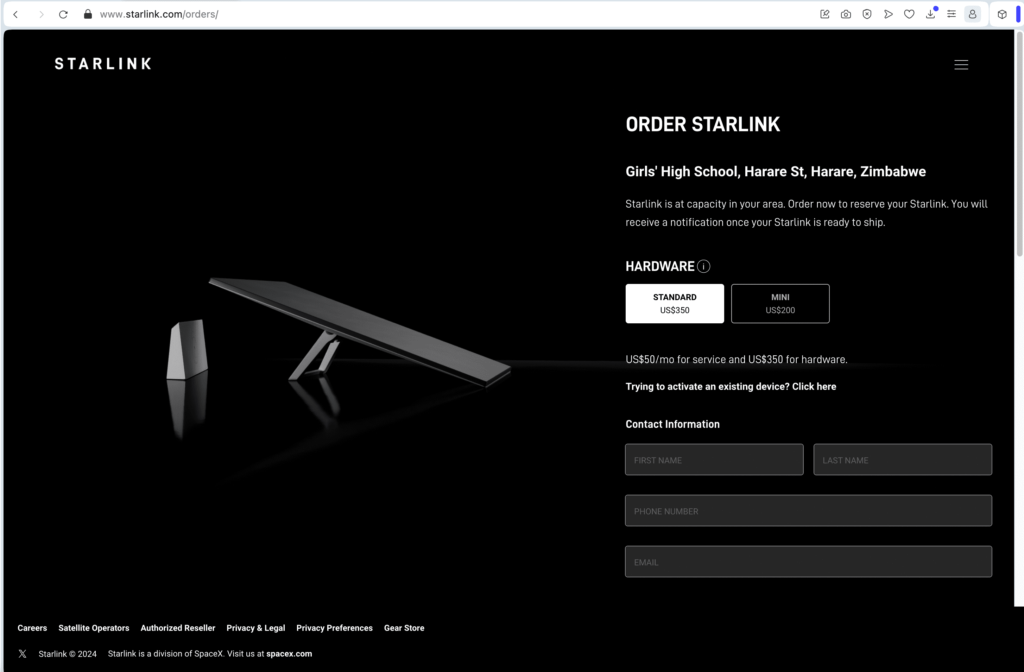
Once you have chosen your hardware type, enter your contact details as well as shipping address. Choose the place Order button and you will be redirected to the payment page.
Payment methods accepted
Here are the acceptable payment options from people who have recently managed to purchase their kits:
- Credit Cards: Acceptable payment methods are: International Visa and MasterCard issued by banks that support global transactions, such as BancABC, Steward Bank, and FBC.
- Mobile Money Virtual Cards: you can as well pay using virtual cards from services like EcoCash and O’mari.
Important: Please ensure your chosen payment method has sufficient funds to cover the total cost, including any card fees and shipping charges.
Once you place your order, you will be emailed details about your order. Keep checking your email for shipping updates.
How much duty do I pay when importing my kit?
According to a source familiar with Starlink’s logistics, units imported via DHL are shipped under a Destination Duties Paid (DDP) arrangement. This global shipping agreement means that SpaceX, the company behind Starlink, prepays customs duties on behalf of customers. By doing so, SpaceX aims to provide a seamless customer experience, eliminating the potential delays and inconveniences associated with customs clearance processes. As a result, the price listed on the Starlink website includes customs duties, offering customers a transparent and all-inclusive cost.
How long should I wait before my kit arrives?
Your Starlink kit will arrive in 1-2weeks. Just make sure you have provided the correct contact details. To ensure a smooth delivery, please verify that the contact details you provided are accurate and up-to-date. Once the kit arrives, activate it using this guide.
Starlink offices in Zimbabwe
Currently, Starlink has no offices in Zimbabwe. Although they have resellers like Shona Price, TelOne, Dandemutande and Frampol.
Starlink vs Econet vs NetOne vs Liquid Telecommunications
Many are asking what is the likely reaction of Internet service providers like Liquid Telecommunications, TelOne, Econet and NetOne. Well, it is called competition, that is what it does! You either adapt or die. The disadvantage these local companies have compared to Starlink is that you can take it to the village where there is no internet connectivity and go back with it to the city after your break.
Local companies should have lowered their prices before SpaceX entered the market. Research shows that in markets where prices were reasonable, Starlink was never an issue, but Zimbabwe is abuzz because of the higher tariffs charged by local providers. Jobs will be lost as the local internet companies adjust to the new reality!
However, increased competition in the internet market should lead to better services and more affordable prices for consumers, which is a positive outcome for the country as a whole.Our own internet service providers must utilise doing more usage based promotions to induce demand. However, more promotions means more costs of advertising.
We predict Elon Musk will launch an xPhone on Starlink’s Direct-2-Cell technology within 2 years – this will be a competitor to Apple’s iPhone.Imagine a phone with internet access anywhere on the planet – you fly from London to Harare – no sim swap! This will be the biggest technological advancement of our lifetime.
What does the future look like?
Now that Starlink is here and that’s Zimbabwe’s biggest technological advancement of our time. It’s high time content creators hop onto this lucrative deal. If you have started doing so, it’s time to start now. You can be doing website hosting, affiliate marketing or bitcoin mining. There are several promising jobs for the future given high speed internet.
What happens when my kit is stolen?
If your Starling kit is stolen, you’re completely safe. Here is why:
1. Account Linking: The Starlink terminal is directly linked to your personal account. This connection means the device won’t function without the correct account credentials, which the thief wouldn’t have access to.
2. Geolocation Locking: The device is typically locked to a specific service address. If the thief tries to activate the stolen kit in a different location, it won’t work because Starlink requires location verification.
3. Deactivation: You can quickly report the terminal as stolen, and SpaceX can deactivate the device from their end. Once deactivated, the device is essentially a brick with no network connectivity.
4. Tracking: Since the terminal has GPS functionality, it can be tracked, making it riskier for the thief to keep or use it.